Trade shows are built around momentum.
A prospect stops at your booth. There is a real conversation. Maybe they have a problem your team can solve. Maybe they are actively evaluating vendors. Maybe they just told your rep exactly what matters to them.
For a few minutes, the opportunity is alive.
Then the badge gets scanned.
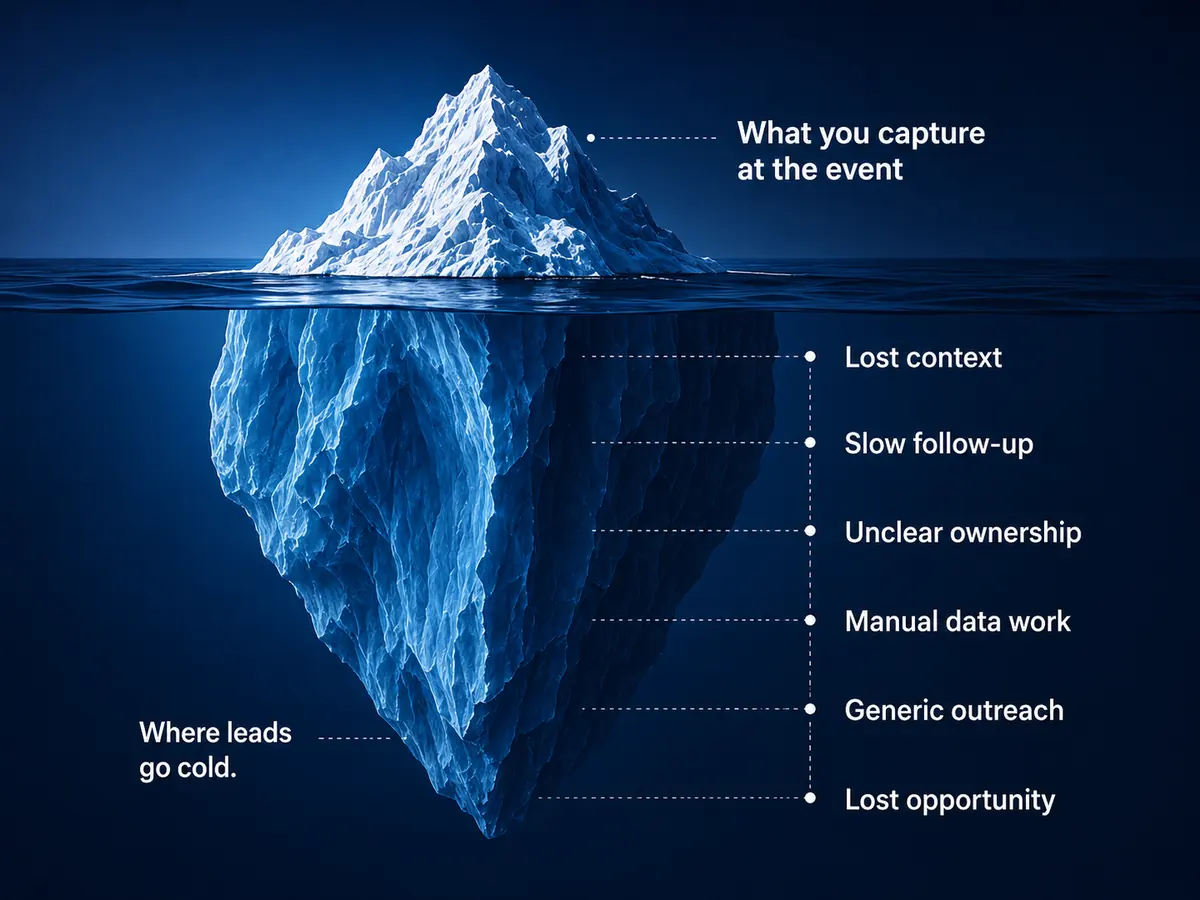
And in too many cases, that is where the momentum starts to die.
By the time the event ends, hundreds or thousands of scans may be sitting in a lead retrieval platform. Someone exports a spreadsheet. Someone cleans it up. Someone uploads it into a CRM. Someone assigns ownership. Reps try to remember who they spoke with. Marketing starts building follow-up campaigns.
Days pass. The prospect has moved on. The context is gone. And the lead that felt important on the show floor now looks exactly like every other row in a spreadsheet.
Five steps between the handshake and the follow-up
Every step adds delay. None of them add context. The queue keeps moving while the conversation cools.
- 1 · ScanCollect contact data
At the booth - 2 · ExportMove it to a spreadsheet
Post-show - 3 · CleanNormalize and dedupe
Day 1–2 - 4 · AssignRoute it to a rep
Day 2–4 - 5 · Follow upOften days later
Day 3–7
Each step is reasonable on its own. The cost is cumulative — and it is paid entirely in the one currency the conversation cannot get back: time.
A lead is not just contact information.
A badge scan can tell you who someone is. It usually cannot tell you why the conversation mattered.
Imagine two people from the same company visit your booth. Both have similar titles. Both scan their badges. Both appear in the CRM as qualified prospects.
But one casually stopped by because they liked the demo. The other told your rep their current provider is failing, their contract expires in three months, they are evaluating alternatives now, their VP wants recommendations, and they want a follow-up meeting next week.
Those are not the same lead. Yet if the only information that survives the event is name, title, company, and email, they can look almost identical.
Context has a half-life.
Immediately after a conversation, a rep remembers the details. An hour later, they remember most of them. After twenty more booth conversations, the edges start to blur.
By the end of a three-day event, reconstructing every interaction accurately becomes nearly impossible. The longer you wait to capture context, the less useful the information becomes.
Memory does not wait for your follow-up
How much of what was learned is still retrievable, measured as savings on relearning. Most of the loss happens before the show floor even closes.
View the data
| 20 minutes | 58.0% |
| 1 hour | 44.9% |
| 9 hours | 22.6% |
| 1 day | 21.1% |
| 2 days | 20.5% |
| 6 days | 11.7% |
| 1 month | 4.1% |
Source: Murre & Dros, “Replication and Analysis of Ebbinghaus’ Forgetting Curve,” PLOS ONE (2015). Savings scores measured on nonsense syllables, not sales conversations — the precise figures will not transfer to a booth. The shape is the point: the steepest loss happens in the first hours, long before most follow-up begins.
The handoff is where opportunities disappear.
Who owns the lead? What should happen next? Is this a sales follow-up, a technical follow-up, a meeting request, or a nurture campaign? Should someone respond tonight, or wait until after the show?
Traditional event workflows often postpone those decisions until after the event. That creates an operational bottleneck. Every handoff adds time, and every handoff creates another opportunity for context to disappear.
Generic follow-up is often a symptom of missing context.
When companies do not know what happened during the conversation, they have very few options. So the follow-up becomes generic: “Thanks for stopping by our booth.” “Great meeting you at the show.” “Would you like to schedule some time?”
There is nothing inherently wrong with those messages. But they leave a tremendous amount of value on the table.
Generic follow-up is a symptom, not a style choice
Subject: Great meeting you at the show!
Hi Jamie,
Thanks for stopping by our booth last week. It was great connecting. Would you like to schedule some time to learn more about what we do?
- No reference to the actual problem
- No sense of their timing
- No clear next step
Subject: The November renewal you mentioned
Hi Jamie,
You mentioned your team is replacing the current integration platform before the November renewal, and that your VP wants a recommendation first.
- Names the problem they raised
- Uses the timing they gave
- Proposes a specific next action
Speed matters, but relevance matters more.
There is a lot of discussion around speed-to-lead. And speed absolutely matters. But sending a generic email five minutes after a conversation is not necessarily better than sending a highly relevant one thirty minutes later.
The real advantage comes from combining both: fast and relevant.
Same event. A different order of operations.
The traditional sequence is built around moving data. The alternative is built around preserving the moment.
The data-first sequence Days
Context is something you try to recover at the end, from memory.
The moment-first sequence Minutes
Context is captured while it still exists, and every later step inherits it.
The event should produce action, not a spreadsheet.
A spreadsheet is useful. It is not the outcome.
The outcome is that the right rep knows who to contact, understands why the lead matters, sees high-priority opportunities immediately, has the right follow-up ready, and can act while interest is still high.
The best lead retrieval system should preserve momentum.
The moment after a great booth conversation is one of the highest-intent moments an event team gets. The prospect is engaged. The rep understands the situation. The context is fresh. The next action is often obvious.
That is exactly when the workflow should begin.
Not three days later. Not after the spreadsheet is cleaned. Not after someone remembers to upload the leads.
The real opportunity in modern lead retrieval is not simply capturing more people. It is preventing good conversations from turning into cold rows of data.
Great conversations shouldn’t turn into cold data.
SignalThread helps event teams capture what matters, prioritize intelligently, and turn the next step into action while the event is still happening.